Our Heritage: Living Pura Vida
WHY CHOOSE US?
A flamenco show at the best tablao in Seville
Tangos, sevillanas, bulerías, seguiriyas… at the El Palacio Andaluz flamenco tablao, you’ll enjoy a flamenco show brimming with emotion, improvisation, duende, and passion.
A journey through the origins of this Andalusian art form in a traditional tablao with an unbeatable production. Professional artists who give it their all every time they step onto our stage.
show Selected to promote flamenco for its visual quality and artistic value
A one-and-a-half-hour performance directed by Emilio Ramírez, “El Duende,” the lead dancer, choreographer, and artistic director of this show brimming with emotion and passion.
This show has been selected by Televisión Española to promote and disseminate flamenco nationally and internationally, due to its visual quality, its artistic value, and its status as a model and example of Spain’s most deeply rooted popular culture.
You won't see a flamenco show like this anywhere else in Seville
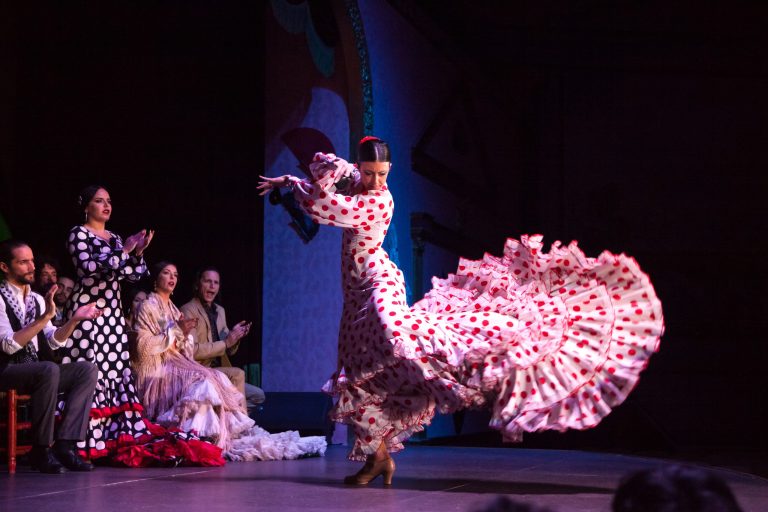
The lights come on and the performers enter the tablao to the rhythm of the alegrías. The female dancers appear in their spectacular bata de cola dresses. Waving them requires refined technique—a skill our performers possess, as they demonstrate on the tablao.
They showcase an unmistakable style and unparalleled talent by combining the movements of the bata de cola, the fan, and the castanets, while the male dancers complete the performance with their distinctive heel-tapping and movements.
The flamenco shawl is also present on the tablao, an element that lends elegance and beauty to the dance, thanks to the dancer’s movements. Achieving that visual appeal is no easy feat, as it requires excellent technique.
It’s not simply a matter of waving the shawl; rather, it must be done in time with the music, and the shawl must serve as an extension of the dancer’s body. The shawl should dance in sync with the dancer’s arm movements, with the appropriate rhythm and strength. Depending on the style being performed, the emphasis of the movement varies.
Next, our artists perform some of the most representative flamenco styles of pure, traditional dance: soleá por bulería, fandango, tiento, guajira… giving free rein to their talent.
That is when one of the show’s most magical moments occurs. The flamenco guitar bursts in, accompanied by the distinctive sound of the castanets.
A piece performed by a guitarist and a dancer—a dialogue between these two instruments that creates a unique atmosphere brimming with emotion.
In the next segment, flamenco gives way to classical Spanish dance. Capes and fans fill the stage, and an excerpt from Bizet’s famous opera *Carmen* begins—one of the works most frequently adapted for flamenco due to its aesthetic and plot.
Several scenes are performed: the protagonist Carmen’s fight with the cigarette seller and the soldiers; a duet between José, the soldier, and Carmen; the legendary scene between the bullfighter and Carmen; and a spectacular finale, with all the performers on stage. A true tribute to Spanish Classical Ballet, a bastion of tradition and culture.
Typically, the concept of Spanish classical ballet is often equated with flamenco dance. In fact, Spanish classical music has adapted quite well to this genre, with pieces by composers such as Manuel de Falla, Maestro Jiménez, and, of course, Georges Bizet, with *Carmen*.
This style blends classical ballet, flamenco, and regional dance. It requires meticulous physical and technical training, as well as mastery of the castanets. A piece that offers a deep dive into a genre representative of Spanish culture.
And with that, we move on to one of the moments most eagerly anticipated and applauded by the audience: a solo in which the lead dancer performs on top of a table, followed by a duet with a flamenco cajón, where the musician plays in time with the dancer’s footwork—a unique moment to appreciate the richness of flamenco rhythm.
The flamenco performance continues with a “martinete” and “seguiriyas,” styles that lead up to Seville’s most iconic and widely recognized dance, the “sevillanas,” which, in turn, give way to a grand finale in the purest flamenco style: a “bulería” performed by all the artists.
It is a style in which joy, commotion, and revelry bring a unique flamenco show—full of artistry and emotion—to a close.